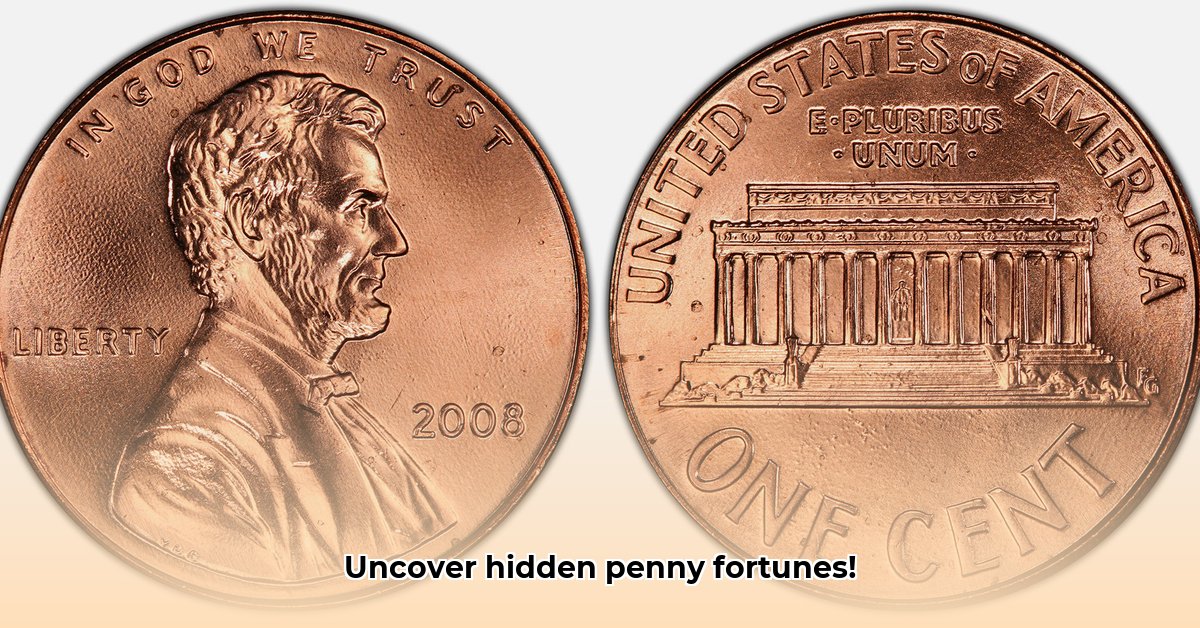
Unearthing Treasure: A Guide to 2008 Penny Errors
Have you ever considered that a seemingly ordinary 2008 penny might be worth a surprising amount of money? Certain 2008 pennies, bearing minor minting mistakes, can be worth hundreds, even thousands of dollars! This guide will teach you how to identify and potentially profit from these hidden gems. We'll cover identifying error types, grading and valuation, market analysis, acquisition strategies, and building a collection. This isn't just about luck; it's about understanding numismatics (the study of coins and currency).
The most valuable 2008 penny errors fall into three main categories: double-strikes, broadstrikes, and brockages. A double-strike occurs when the coin is struck twice by the minting press, resulting in a doubled image of the design. A broadstrike happens when the coin isn't centered properly, leading to a partial or off-center image. Brockages, the rarest, occur when a coin is struck with another coin still in the die, leaving an imprint. Isn't it fascinating how these tiny imperfections can dramatically increase value?
Identifying Error Types: A Closer Look
Several types of errors dramatically increase a penny's value. Let's explore the most sought-after:
- Doubled Dies: A flawed die creates a double image of the design. The degree and position of the doubling determine value.
- Broadstrikes: Improper planchet (the blank metal disc) placement in the press results in a partial design impression.
- Off-Center Strikes: Significant misalignment leaves a large portion of the design missing.
- Wrong Planchets: A planchet of the wrong size or metal is struck, creating a unique error.
Even slight variations can greatly impact worth. High-quality images are invaluable during your analysis.
Grading and Value: The Sheldon Scale's Impact
The Sheldon Scale, ranging from 1 (poor) to 70 (perfect), is the numismatic grading standard. Higher grades mean higher values. A well-preserved error coin in Mint State (MS) condition, such as MS65 or MS70, commands top prices. For example, a perfectly preserved 2008 double-struck penny graded MS65 could sell for several hundred dollars, while the same error in poorer condition (say, MS60) might only fetch fifty. This highlights the crucial role of grading in determining a coin's value. Do you understand the significance of condition yet?
Market Trends: Navigating the Fluctuations
The error coin market is dynamic, influenced by supply and demand. Rarity and visual appeal drive prices. Researching recent auction results for similar error coins is crucial. Online auction sites and numismatic publications provide current market information. Remember, a truly unique error will command a significant premium. Therefore, continuous monitoring of market trends is essential.
Acquisition Strategies: Sourcing Your Treasures
Where to find these valuable pennies?
- Online Auctions (e.g., eBay, Heritage Auctions): Offer a wide selection but necessitate careful scrutiny of descriptions and images to avoid counterfeits.
- Reputable Coin Dealers: Provide guaranteed authentication and expert knowledge but often charge higher prices.
- Coin Shows: Offer in-person inspection and networking opportunities, but availability is geographically limited and time-sensitive.
Authentication: Ensuring Authenticity
Authentication is paramount. Counterfeit error coins exist. For high-value coins, professional authentication from reputable grading services like PCGS 1 or NGC is recommended. Their certification adds significant value and legitimacy. This is a vital step in protecting your investment.
Building Your Collection: A Long-Term Strategy
Diversify your collection! Don't focus solely on one error type. Spread your investments across various errors and grades to mitigate risk. Regularly research market trends and update your collection strategy accordingly. Patience and knowledge are key to long-term success in numismatics. The thrill of the hunt is only surpassed by the continual learning involved!